LebanonFiles – Premiered on 3 Jun 2026 7aki Net
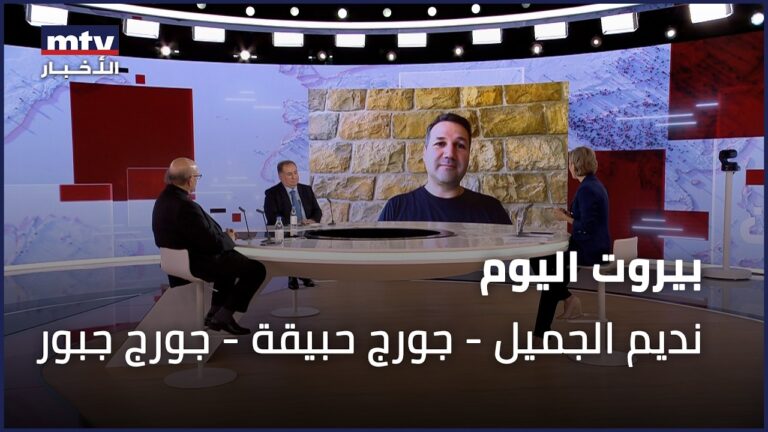
George Jabbour: No external party can ignite a civil war if “the people don’t want it,” and there’s simply no possibility of that happening. In Lebanon, there is no state; decisions are dictated to us, not made. The Taif Agreement stopped the guns, but it didn’t end the war. Berri was and remains the most powerful man and the decision-maker. Geographic federalism is not the solution.
George Jabbour’s core stance revolves around the dysfunction of the current centralized Lebanese system, the complete absence of state sovereignty, and his advocacy for a specific federal model as the only viable solution for Lebanon’s pluralistic society.
His position can be summarized across four key pillars:
1. The State of “No State” (لا دولة) and Loss of Sovereignty
- Decisions are Dictated Externally: Jabbour asserts that Lebanon has “no state” capable of making or executing decisions. Instead, major decisions are dictated to Lebanon from the outside.
- Bypassing the Government: He highlights that during ceasefire negotiations, the Lebanese state has been entirely marginalized. External powers, such as the U.S. and Iran, negotiate regional arrangements directly, while Israel acts unilaterally in Lebanon. The state does not even have direct lines of communication with major internal combatants like Hezbollah.
2. The Failure and Sectarian Imbalance of the Taif Agreement
- A Truce, Not a Solution: Jabbour acknowledges that the 1990 Taif Agreement successfully “stopped the cannon” (ended active military conflict). However, he maintains that it did not actually end the underlying political war in Lebanon.
- Marginalization of Christians: He argues that Taif severely weakened and marginalized Lebanon’s Christian population by excluding their core leadership, altering demographic balances through the 1994 naturalization decree, and failing to enforce the disarming of all militias (specifically Hezbollah and Amal). This imbalance was further worsened by the 2008 Doha Agreement, which introduced sectarian blocking mechanisms.
3. The Solution: Ethno-Geographic Federalism (الفيدرالية الإتنوغرافية)
- Rejection of Centralized Governance: Jabbour argues that a highly centralized, unitary state is completely unsuited for Lebanon’s highly diverse and pluralistic “mosaic” society.
- Ethno-Geographic vs. Pure Geographic Federalism: He explicitly rejects “pure geographic federalism,” warning that it would isolate and crush minorities living in majority-dominated areas. Instead, he champions “Ethno-Geographic” or “cultural-geographic” federalism.
- Local Autonomy: Under this model, Lebanon’s distinct sectarian components (Christian, Sunni, Shia, Druze) would be granted administrative, financial, political, and legislative autonomy within their respective regions.
- Redefining Coexistence (العيش المشترك): Jabbour insists that true coexistence cannot exist if one group forces others to adapt to their lifestyle. Real coexistence means respecting differences and letting each community live freely according to its own culture and history under a unified federal framework.
4. The Impossibility of a New Civil War
- The People Must Want War: Despite current political tensions and displacement, Jabbour firmly believes a new Lebanese civil war is impossible.
- Exhausted Population: He argues that external forces cannot ignite a civil war if the local citizens (“Al-Ahel”) refuse to participate. Today, unlike in 1975, the Lebanese people are financially, socially, and psychologically depleted—lacking the financial resources, currency stability, jobs, or international backing required to sustain a domestic war.